UDYOG PORTAL

For any Query Email Us - info@eudyogaadhar.in
( Portal for MSME (Udyam) Registration )

सूक्ष्म , लघु और मध्यम उद्यम | जीएसटी पंजीकरण परामर्श केंद्र

Udyam registration portal in india / उद्यम पंजीकरण पोर्टल

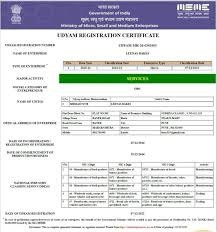
* With effect from 1st July 2020, MSME/ Udyog Aadhaar Registration will now be called as Udyam Registration.
Certificate Benefits : - * Life Time Validity * Approved By MSME Department * For Open Current Bank Account * Business Registration Proof * Collateral Free Loan

Author name: admin123

Udyam Registration In Odisha

Udyam registration in Odisha

Udyam registration in Odisha has evolved into one of India’s most accelerated industrial frontiers. From the metallurgy and manufacturing hubs of Jharsuguda to the master craftsmanship of Cuttack and the digital innovation corridors of Bhubaneswar, the state’s entrepreneurs are redefining its economic future. In 2025, hard work is only half the battle. To scale, businesses need strategic integration. Under the Odisha MSME Development Policy 2025, Udyam Registration is the foundational key. It is your official passport to state-level power subsidies, land concessions via IDCO, and specialised financial incentives. What is Udyam Registration In Odisha?  The Definitive MSME Identification Udyam Registration is the official government certification managed by the Ministry of MSME. Unlike previous systems, the 2025 Udyam portal is directly linked to Income Tax and GST databases, ensuring that your business classification is automatically verified and updated. This integration provides a high level of financial credibility, making it significantly easier for Odisha’s businesses to secure collateral-free loans under the CGTMSE scheme and participate in reserved government tenders. Why is this important for businesses in Odisha? Why Odisha Entrepreneurs Can’t Afford to Skip Udyam Registration in Odisha  transforming into a global industrial hub. Without Udyam Registration, your business remains “invisible” to massive state-backed advantages. Fiscal Incentive Eligibility: Acts as the mandatory gateway for claiming Capital Investment Subsidies (CIS) on plant and machinery. Industrial Infrastructure Access: Simplifies applications for land allotment in industrial estates managed by IDCO at concessional rates. Operational Cost Reduction: Enables units to claim Electricity Duty exemptions and power tariff reimbursements, significantly lowering overheads. Statutory Procurement Rights: Grants “Purchase Preference“ in state government tenders, ensuring local MSMEs are prioritised over larger, non-local competitors. Eligibility for business registration Enterprise Registration: New Eligibility at a Glance.  Now, all businesses with a turnover of up to ₹10 crore will be classified as Micro enterprises. Companies with a turnover of up to ₹100 crore will fall under the Small category, and businesses with a turnover of up to ₹500 crore will be considered Medium-sized enterprises. This new formula, based on investment and turnover, will serve as the basis for you to avail government subsidies and electricity bill concessions. Step-by-Step Udyam Registration (Short & Reworded) The Udyam Registration in Odisha process is simple and fully online. There is no need to visit any government office or agent—you can complete everything using your mobile or computer. Filing of application for Udyam Registration For the initial process of your business, fill out all the required documents Correctly in the MSME registration form so that your information is complete and accurate for easy access.  Completed the payment process online  Make your payment securely with just a few clicks. Fast, safe, and hassle-free The team will work on your application. Our expert team will contact you and carefully process your Udyam Registration in Odisha application by asking for some details. Receive the certificate in  your Gmail Once the Udyam Registration is approved, the certificate is sent directly to your provided email address, which you can easily download   Required Documents This process in Bihar is completely paperless. You will only need the following information: Aadhaar Card: Must be linked to your mobile number (for OTP verification). PAN Card: Personal or company PAN card. Bank Account: Bank passbook or a cancelled check (for IFSC code). GSTIN: If your turnover falls under the GST ambit (mandatory since April 1, 2021). Business Address: The exact address of your office or factory in Bihar. Opportunities for Specific Regions of Odisha Udyam registration holds different meanings for various regions of Odisha: Sambalpur and Bargarh (Handloom): Weavers in these regions can avail of low-interest Mudra loans and subsidies on yarn purchases through Udyam registration. Puri and Konark (Tourism): If you run a homestay or travel agency, Udyam registration in Odisha can provide you with tax benefits under the ‘Service Sector’ category. Get Paid to Grow: Odisha Startup Alert Running a tech unit in Bhubaneswar or Cuttack? Without Udyam Registration, you can’t claim your monthly allowance from ‘Startup Odisha.’ Get registered today to unlock 12 months of financial support and turn your IT vision into a verified industrial success. Things to keep in mind during registration: Do not fill in incorrect information: The turnover and investment details should match your Income Tax Return (ITR). Zero-Cost Registration: Udyam is free. Do not pay agents in Odisha ₹1,000+ for a service you can do yourself. Need help? Visit your local DIC office for free assistance. GST is Key: A GST number is now practically mandatory for all growing businesses. It ensures your turnover data is automatically verified, keeping your MSME status official and bank-ready. Final Thoughts From Local Business to State Powerhouse, Oisha is on the move, and its entrepreneurs are the ones in the driver’s seat. Whether you are scaling a tech startup in Bhubaneswar or a manufacturing unit in Jharsuguda, Udyam Registration is your passport to growth. The state government has paved the way with “Single Window” approvals and massive power subsidies, but these benefits are reserved for those who leap the formal economy. Don’t let your business stay in the shadows—get registered today and secure your place at the front of the line for every government incentive available.

Udyam registration in Odisha Read More »

Delayed Payment Protection

Delayed Payment Protection

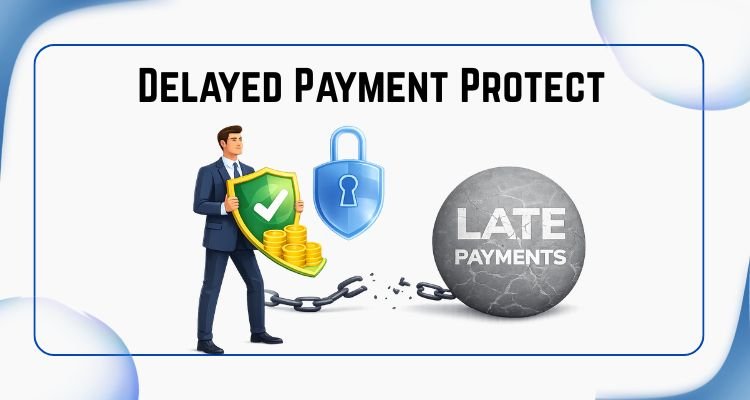
Delayed Payment Protection: Strong Shield for MSMEs   In today’s fast-paced business environment, Micro and Small Enterprises (MSEs) often face critical challenges—particularly cash flow disruptions arising from delayed payments. While selling on credit is commonplace, delayed or non-payment can jeopardize the very survival of small businesses. Recognizing this, the Government of India has empowered state-level Facilitation Councils under the MSME Development Act, 2006. These councils offer legal recourse through conciliation and arbitration to resolve payment disputes efficiently and effectively What is Delayed Payment Protection At its core, Delayed Payment Protection is a suite of services or insurance products aimed at mitigating the risks associated with credit sales. It essentially guarantees that you receive your funds, regardless of whether your client is experiencing a temporary cash crunch or facing insolvency. There are several ways this protection manifests in the market today: Trade Credit Insurance (TCI) This is the most comprehensive form of protection. If a customer fails to pay due to protracted default (they just won’t pay) or insolvency (they’ve gone bankrupt), the insurance provider covers a significant percentage of the debt—usually 80% to 95%. Invoice Factoring & Discounting While often viewed as a financing tool, many factoring agreements include “non-recourse” clauses. This means the factor (the company buying your invoice) assumes the risk of non-payment. If the client doesn’t pay, the factor takes the hit, not you. Digital Payment Guarantees Modern fintech platforms now offer “Buy Now, Pay Later” (BNPL) for B2B transactions. The platform pays the vendor immediately and takes on the responsibility of collecting the payment from the buyer over time Why This Matters for Your Growth Delayed payment protection isn’t just about getting your money; it’s about predictability.Working Capital Stability: When you know your funds will return within 45 days, you can plan your next production cycle, buy raw materials, and pay your staff without taking expensive short-term loans.Negotiating Power: Being “Udyam Registered” tells your buyer that you are aware of your legal rights. It changes the power dynamic from a “beggar” to a “partner.”Reduced Bad Debts: The threat of 3x interest and tax penalties significantly reduces the chances of a buyer “ghosting” you or refusing to pay for minor, unjustified reasons.   Why “Human-Centric” Protection Matters Many automated systems treat debt collection like a blunt instrument. However, in business, relationships are everything. Effective Delayed Payment Protection acts as a neutral third party. It allows you to maintain a positive relationship with your client while a professional system handles the financial logistics. Instead of you being the “bad guy” demanding money, the protection framework provides a structured, professional expectation that payments are non-negotiable. How to Choose the Right Protection for Your Business Not every business needs a full-scale credit insurance policy. Choosing the right “shield” depends on your specific industry and client base. For Freelancers: Look for platforms that offer Escrow services or integrated “Late Fee” automation. Setting up a contract that automatically triggers a $5%$ or $10%$ penalty for every week a payment is late is a simple, low-cost form of protection. For Manufacturers: Trade Credit Insurance is vital here. With high overhead costs and large material outlays, a single massive unpaid order could lead to bankruptcy. For Service Providers: Consider milestone-based payments. By breaking a project into four parts and requiring payment before moving to the next phase, you protect yourself from losing the full value of your labor. Strategies to Prevent Delays Before They Happen While protection products are your safety net, your “front-line defense” should be your internal processes. Clear Terms and Conditions: Never start work without a signed contract that explicitly states payment deadlines (e.g., Net 15 or Net 30). Credit Checks: Before offering credit to a new client, do your homework. Use credit reporting agencies to see if they have a history of slow walking payments. Early Bird Incentives: Offer a small discount (e.g., $2%$) if the invoice is paid within 7 days. It is often cheaper to give a small discount than to pay interest on a loan because your cash is tied up. The Psychological Shift: From “Hoping” to “Knowing” The biggest advantage of Delayed Payment Protection is often psychological. Business owners spend a significant amount of “mental bandwidth” worrying about money that hasn’t arrived yet. When you implement a protection strategy, that anxiety vanishes. You shift from a defensive posture—wondering if you can afford next month’s rent—to an offensive posture, focusing entirely on how to provide better value to your customers and grow your brand. Pro Tip: In the digital age, “the check is in the mail” is no longer an acceptable excuse. Moving your clients toward digital payment portals that support credit cards or ACH transfers reduces the friction that often leads to “accidental” delays. Understanding the Issue: Why Delayed Payments Hurt MSMEs Reliable cash flow is the lifeblood of MSMEs. Delays in payments—from lengthy approval processes to disputes—can: Deplete working capital Delay procurement of raw materials Disrupt payroll and overheads Hamper growth plans Given their limited financial buffers, recovery of dues can mean the difference between growth and closure. Thus, prompt dispute resolution is not just desirable—it’s essential.   How the Small Business Commissioner Can Help The SBC is an independent public body that provides free support and advice to small businesses dealing with late payment issues. Services include: Advisory Services – Guidance on how to prevent and manage late payments. Complaint Resolution – Assisting small businesses in resolving disputes with larger firms over unpaid invoices. Webinars and Educational Resources – Free workshops, webinars, and guidance on improving payment practices. Practical Steps to Avoid Late Payments   Final Thoughts Delayed Payment Protection is no longer a luxury reserved for Fortune 500 companies. In an era of economic volatility, it is a fundamental requirement for any business that operates on credit. By securing your receivables, you aren’t just protecting a piece of paper; you are protecting your employees’ livelihoods, your professional reputation, and your future growth. Don’t wait for a “bad debt” to ruin your year.

Delayed Payment Protection Read More »

Udyam number forgotten

Udyam number forgotten, and registered mobile number and email id forgotten. How to download Udyam certificate.

UDYAM NUMBER FORGOTTEN If you’ve lost your Udyam Registration Number (URN) and can’t access the registered mobile number or email, getting your Udyam certificate might be a challenge. Nonetheless, there are still ways you can attempt to retrieve it:Important Tips: Ensure that your Aadhaar is connected to your business for smooth operations. If you register using your Aadhaar, authorities will be able to track your registration process. After retrieving your URN, you can conveniently download the certificate from the portal. Visit a Nearby MSME-DI Office: You may also want to stop by your nearest District Industries Centre (DIC) or MSME Development Institute in person with: – Aadhaar Card   – PAN Card   – Any proof of business registration (GST or, if available, old Udyog Aadhaar)   – Application or declaration outlining the issue   Try to Recover Udyam Number via Official Portal (If You Regain Access) If you’re able to access either the mobile number or email associated with your Udyam registration, here’s what you can do: 1. Visit the Udyam portal: https://udyamregistration 2. Click on “Forgot Udyam Registration Number.” 3. Enter your Aadhaar number along with any other necessary details. 4. You’ll receive your URN sent to your registered mobile number or email. What is Process UDYAM Certificate Udyam Certificate Process: Step-by-Step Guide:- The Udyam Registration Certificate is granted by the Ministry of MSME, Government of India, to officially classify a business as a Micro, Small, or Medium Enterprise (MSME). Below is a detailed guide on how to apply for and download your Udyam certificate: Step 1: Visit the Official Portal Go to the Udyam Registration website:👉 https://eudyogaadhar.in/ Step 2: Aadhaar-Based Registration For: You will also need: Step 3: Fill the Online Form Provide the following: Step 4: OTP Verification Step 5: Get Udyam Certificate Updating Details (Optional) If you need to update any information, use the “Update Udyam Registration“ option on the same portal. APPLY UDYAM REGISTRATION MSME REGISTRATION UDYOG REGISTRATION

Udyam number forgotten, and registered mobile number and email id forgotten. How to download Udyam certificate. Read More »

MSME

How to apply MSME Registration through Startup India

Here is a detailed instruction on how to register as an MSME in order to apply for Startup India benefits: How to Apply for Startup India through MSME Registration: A Comprehensive Guide. Sign Up for Your MSME: Go to the registration portal for Udyam. Enter your business information and Aadhaar number in the box. You will obtain an MSME (Udyam) certificate upon submission. Make an account with Startup India: Visit the website www.startupindia.gov.in. After selecting “Register,” enter your business and personal details. To be considered for DPIIT Recognition: Go to your Startup India profile and log in. On the DPIIT Recognition tab, select “Get Recognized.” Provide information such as the type of the firm, invention, and the certificate of company incorporation. As supporting paperwork, upload the MSME registration certificate. Awaiting Acceptance: You will receive Startup India designation after being validated by DPIIT, which opens doors to advantages including tax breaks, financial assistance, and simpler compliance. The advantages of applying through MSME registration  >include access to Startup India and MSME programs. >quicker approval process because the company’s identification has been confirmed. >Dual eligibility for government credit, mentoring, and subsidies. Under the Startup India initiative, the following are the main rewards and advantages for startups:- Important Startup India Incentives & Advantages: Key Incentives and Benefits for Startups under Startup India: > DPIIT Acknowledgment Startups acknowledged by the Department for Promotion of Industry and Internal Trade (DPIIT) receive access to a variety of government advantages and assistance programs. >Tax Exemptions Enjoy a 3-Year Income Tax Holiday as outlined in Section 80-IAC. Take advantage of exemptions on Capital Gains and investments exceeding fair market value. >Startups Simplifying Public Procurement Established startups can now participate in government tenders without needing prior experience or specific turnover levels, and they can take advantage of more flexible EMD standards. >Streamlined IPR Processing Enjoy an 80% discount on patent fees Quick reviews for your patent and trademark applications Free access to IPR facilitators for your support >Self-Certification for Compliance Startups have the opportunity to self-certify under six labor laws and three environmental laws, making it easier to manage regulatory requirements. >The Startup India Seed Fund Scheme (SISFS) offers a grant of up to ₹20 lakh for validation and an investment of ₹50 lakh to support commercialization and scaling efforts. >Access to Funding via AIFs Startups that meet the eligibility criteria can tap into a substantial ₹10,000 crore Fund of Funds for Startups (FFS) managed through venture capital funds registered with SIDBI. >Incubation and Mentorship Programs Startups have the opportunity to participate in government-supported incubators, accelerators, and mentorship programs, which can significantly speed up their growth. >Easy Winding Up Startups have the option to close their operations in as little as 90 days, thanks to the provisions of the Insolvency and Bankruptcy Code. CONCLUSION The collaboration between MSMEs and the Startup India initiative represents a significant leap forward in boosting innovation, entrepreneurship, and economic growth in India. MSMEs are vital to the Indian economy, playing a critical role in job creation, industrial output, and exports. With the support of the Startup India program, these enterprises now have improved access to financing, streamlined regulations, tax incentives, and a robust ecosystem that fosters innovation and growth. This partnership not only strengthens the competitiveness of MSMEs but also supports the rise of tech-driven startups with innovative ideas. Consequently, there’s a harmonious blend of traditional and modern businesses, paving the way for inclusive growth and sustainable development. To maintain this positive trajectory, ongoing support through policy reforms, infrastructure development, skills training, and digital integration is essential. Ultimately, MSMEs backed by the Startup India initiative have the potential to become dynamic forces for job creation and economic resilience, steering India toward becoming a global center for innovation and entrepreneurship. UDYAM REGISTRATION MSME REGISTRATION UDYOG REGISTRATION UDYAM CERTIFICATE

How to apply MSME Registration through Startup India Read More »

MSME REGISTARTION

Affordable Tech Solutions for MSMEs

Why are affordable tech solutions important for MSMEs? Affordable tech solutions are crucial for MSMEs because they operate with limited financial and human resources. Cost-effective technology allows them to improve efficiency, reduce manual errors, and stay competitive without large investments. These tools help MSMEs streamline operations, reach new customers, and manage data more effectively. Whether it’s using free project management tools, low-cost CRM software, or cloud-based accounting systems, affordable tech bridges the gap between small enterprises and large corporations. It also supports scalability, so as businesses grow, they can upgrade gradually. In short, tech enables MSMEs to do more with less, promoting growth and sustainability. What are some popular low-cost tech tools used by MSMEs? Budget-friendly instruments with excellent functionality are commonly used by MSMEs.  Tools like Tally, Wave, and Zoho Books are widely used for accounting.  Tools like Trello, Slack, and Asana simplify project coordination and enhance team collaboration.  Zoho CRM and HubSpot (free version) work well for client connections.  Google Workspace offers collaboration, storage, and email services for a low cost.  A lot of people utilize Canva for marketing design.  Online retail  Platforms like Shopify and WooCommerce are advantageous to MSMEs.  For startups and small enterprises wishing to digitize without going over budget, these tools are perfect because they are either free or have reasonable price options. How can MSMEs use technology to improve customer engagement? Affordable tech allows MSMEs to personalize and improve customer experiences across platforms. CRM tools help track customer behavior, automate follow-ups, and manage sales pipelines. Email marketing platforms like Mailchimp allow MSMEs to send targeted messages and updates. Social media management tools like Buffer and Later help maintain consistent engagement. Chatbots or WhatsApp Business can provide instant customer service even during off-hours. These digital tools not only enhance communication but also build stronger, long-term customer relationships. Better engagement leads to higher satisfaction, improved brand loyalty, and ultimately, increased sales—all at a low cost. What role does cloud computing play in affordable tech for MSMEs? Cloud computing has revolutionized access to affordable tech for MSMEs by eliminating the need for expensive infrastructure. With services like Google Cloud, Microsoft Azure, or AWS, MSMEs can store data securely, access it remotely, and collaborate in real-time. Cloud-based tools offer scalability—start small and expand as needed—making them ideal for growing businesses. These solutions also ensure data backup, software updates, and cybersecurity without requiring in-house IT teams. From file storage to accounting and CRM, cloud platforms offer a cost-efficient, flexible way for MSMEs to adopt advanced technologies and remain agile.  Are there government schemes promoting affordable tech for MSMEs? Yes, several government initiatives promote the adoption of affordable technology by MSMEs. In India, schemes like Digital MSME and Technology Centre Systems Programme (TCSP) help MSMEs upgrade to digital tools. The MSME Champions Portal offers support, tools, and mentoring. Credit schemes like MUDRA loans also enable small businesses to invest in technology. Additionally, subsidies are available for ERP software adoption under certain state policies. These programs are designed to reduce cost barriers and encourage technology adoption to enhance productivity, improve quality, and boost global competitiveness for MSMEs.  What are the main barriers MSMEs face in adopting tech solutions? Despite the availability of affordable tools, MSMEs often face challenges in adopting technology. A major barrier is the lack of digital literacy among business owners and employees. Many are unfamiliar with the benefits or operation of tech tools. Even minimal initial setup costs can discourage businesses operating on tight budgets. Poor internet connectivity, especially in rural areas, also limits access. Some MSMEs fear data privacy risks or feel overwhelmed by tech complexity. To overcome these, awareness campaigns, training programs, and government support are essential in encouraging widespread tech adoption among MSMEs. How can MSMEs ensure successful implementation of tech solutions? To ensure successful tech adoption, MSMEs should begin by identifying pain points in their operations and selecting tools that directly address them. Training employees and allocating someone to manage tech platforms ensures better use. Choosing user-friendly, scalable, and well-supported tools is key. MSMEs should also monitor usage and collect feedback regularly for improvements. Integrating multiple tools (like CRM with email or accounting with inventory) enhances efficiency. Lastly, cybersecurity should not be overlooked—using strong passwords, enabling two-factor authentication, and securing cloud access are essential steps. A step-by-step approach ensures tech adoption adds real value to the business. APPLY UDYAM CERTIFICATE APPLY UDYAM REGISTARTION APPLY MSME REGISTARTION

Affordable Tech Solutions for MSMEs Read More »

Digital Transformation for MSMEs

Digital Transformation for MSMEs

Digital Transformation for MSMEs Digital Transformation for MSMEs is unlocking new growth opportunities through technology-driven innovation. Digital Transformation for MSMEs helps streamline operations, reduce costs, and improve productivity. Digital Transformation for MSMEs plays a vital role in increasing competitiveness in both local and global markets. Digital Transformation for MSMEs enables better customer engagement through online platforms and digital marketing. Digital Transformation for MSMEs is essential for adapting to rapidly changing consumer behaviors and market demands. Digital Transformation for MSMEs receives strong support from government initiatives and tech-based policy reforms. What does digital transformation for MSMEs mean in today’s business landscape? Digital transformation for MSMEs refers to the integration of digital technologies into all areas of business operations to improve efficiency, service delivery, and competitiveness. It includes adopting tools like cloud computing, digital payment systems, e-commerce platforms, and automation software. In today’s fast-paced economy, digital transformation is no longer optional; it’s essential for MSMEs to survive and scale. It enables better customer engagement, real-time data analysis, cost optimization, and remote working capabilities. For MSMEs, embracing digital tools ensures access to larger markets, increased operational agility, and the ability to compete with larger enterprises on more equal footing. How can digital tools improve productivity and efficiency in MSMEs? Digital tools can drastically enhance productivity and efficiency in MSMEs by automating routine tasks, streamlining communication, and optimizing resource management. Cloud-based software allows real-time collaboration and data storage, while accounting and inventory management tools reduce manual errors. Customer Relationship Management (CRM) systems help MSMEs manage leads and customer service more effectively. Digital payments and online banking speed up transactions and financial tracking. Moreover, digital HR platforms simplify payroll and attendance processes. These technologies free up time, reduce costs, and allow entrepreneurs to focus on strategy and growth. In essence, digital tools empower MSMEs to operate smarter and faster. What are the main challenges MSMEs face while adopting digital technologies? When implementing digital technology, MSMEs encounter a number of obstacles, such as a lack of funding, a lack of digital literacy, and opposition to change. Due to financial limitations, many small firms find it difficult to invest in new tools. Others don’t have the skills or knowledge needed to use digital platforms efficiently. Adoption is further hampered by infrastructure problems, such as erratic internet availability in rural areas. Additionally, several MSMEs are discouraged from migrating due to worries about data security and the intricacy of technology. In a market that is digitizing quickly, these companies risk falling behind if they don’t receive clear direction and assistance. Building capacity and implementing targeted policy assistance are necessary to remove these obstacles. What effects has e-commerce had on MSMEs’ expansion in the digital era? E-commerce has significantly expanded the growth potential of MSMEs by providing access to wider markets at a relatively low cost. Through platforms like Amazon, Flipkart, and regional marketplaces, MSMEs can now reach national and international customers without the need for a physical storefront. This exposure increases sales opportunities, enhances brand visibility, and diversifies customer bases. E-commerce also enables data-driven decision-making by offering analytics on consumer behavior and sales trends. Moreover, logistics and digital payment integrations simplify operations. Overall, e-commerce has become a critical enabler for MSMEs, especially in the post-pandemic era, where online presence determines business sustainability. What role does government policy play in supporting digital transformation for MSMEs? Government policy plays a vital role in accelerating digital transformation among MSMEs by providing financial assistance, infrastructure development, and training programs. Schemes like the Digital MSME initiative by the Ministry of MSME in India aim to promote IT adoption among small businesses. Subsidies for technology upgrades, grants for ERP tools, and support for cloud services reduce the cost burden. Capacity-building programs and digital literacy campaigns help bridge knowledge gaps. Additionally, policies that simplify compliance through digital portals improve efficiency. A supportive regulatory environment ensures that MSMEs can embrace digital tools confidently and grow in a competitive digital economy. How can MSMEs leverage digital marketing to expand their customer base? MSMEs can use digital marketing to significantly grow their customer base by building brand awareness, engaging with target audiences, and promoting their products cost-effectively. Platforms like Facebook, Instagram, Google Ads, and LinkedIn allow small businesses to run targeted campaigns based on demographics, interests, and geography.

Digital Transformation for MSMEs Read More »

msme

Role of MSMEs in Sustainable and Green Economy

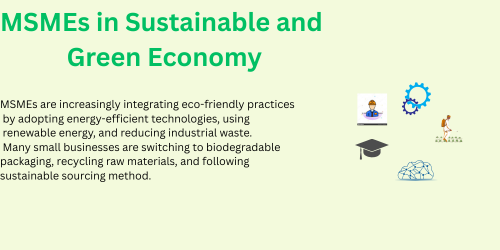
How are MSMEs contributing to the adoption of eco-friendly practices in India? SMEs are increasingly integrating eco-friendly practices by adopting energy-efficient technologies, using renewable energy, and reducing industrial waste. Many small businesses are switching to biodegradable packaging, recycling raw materials, and following sustainable sourcing methods. Industries like textiles, food processing, and handicrafts are particularly active in implementing green manufacturing. MSMEs are also participating in carbon footprint reduction by optimizing logistics and resource use. Additionally, government schemes promoting clean technology adoption have motivated MSMEs to embrace sustainable operations. These efforts collectively support India’s climate goals and demonstrate how small enterprises can drive big changes in environmental protection and sustainability. What are the main challenges faced by MSMEs in transitioning to a green economy? The biggest obstacle facing SMEs as they transition to a green economy is financial constraints. Many may not have the funds to purchase clean technology or new, energy-efficient equipment. Another obstacle is a lack of understanding about sustainable practices and their long-term advantages. Progress is further hampered by a lack of technological know-how, competent labor, and limited access to green financing. Furthermore, smaller businesses may find it difficult to comply with environmental standards. Large-scale adoption of green business models is challenging for MSMEs since they frequently put survival and cost-cutting ahead of sustainability in the absence of sufficient support, education, and incentives. How can government incentives encourage MSMEs to adopt sustainable business models? Incentives from the government are essential for assisting business in switching to sustainable business strategies. The cost burden of implementing eco-friendly technologies can be reduced with financial assistance in the form of green loans, subsidies, and tax breaks. Programs for technical support and training sessions can raise awareness and improve capacity building. Small firms can more easily achieve sustainability through policies that support waste management, energy-efficient procedures, and the use of renewable energy. Wider adoption is also encouraged when green SMEs are acknowledged and rewarded with certifications or preferential treatment in public procurement. By making sustainability a viable choice for SMEs, these focused initiatives help hasten the transition to a green economy. What role does renewable energy play in the sustainability of MSMEs? Renewable energy plays a vital role in improving the sustainability and cost-efficiency of business. By switching to solar, wind, or bioenergy sources, Local Enterprises can reduce their dependence on costly and polluting fossil fuels. This shift not only lowers carbon emissions but also protects businesses from energy price volatility. Rooftop solar installations, for example, offer a long-term power solution with minimal maintenance. Government support through subsidies and grid connectivity has made renewable energy more accessible. As many MSMEs operate in remote or rural areas, decentralized renewable solutions enable uninterrupted operations, supporting both environmental goals and business continuity in a sustainable manner. What are some successful examples of green MSMEs in India or globally? Numerous MSMEs have successfully implemented green models both in India and beyond. For instance, to save energy, Greenwear, an MSME in the Indian textile industry, employs solar-powered looms. Another Indian firm, EcoSoul Home, produces biodegradable cookware and ships it all over the world. Used coffee grounds are recycled globally into environmentally beneficial biofuels by Bio-bean in the UK. EcoPost addresses pollution and infrastructural issues in Kenya by converting plastic trash into long-lasting fencing posts. These illustrations highlight how entrepreneurship, sustainability, and innovation can come together to create successful, environmentally responsible companies. For other MSMEs wishing to embrace green practices and support a sustainable economy, they act as motivating role models. How can MSMEs balance profitability with environmental responsibility? Balancing profitability with environmental responsibility is achievable for MSMEs through strategic planning and innovation. Investing in energy-efficient machinery and waste-reducing technologies can lead to long-term cost savings. Sustainable practices such as recycling, reusing materials, and reducing resource wastage enhance operational efficiency. Branding products as eco-friendly also adds market value and attracts environmentally conscious consumers. Government incentives further reduce the financial burden of green transitions. Additionally, MSMEs that prioritize sustainability often see improved investor interest and customer loyalty. By aligning business goals with environmental values, MSMEs can create a competitive edge while contributing to ecological well-being and economic success.

Role of MSMEs in Sustainable and Green Economy Read More »

Women entrepreneurs in MSME

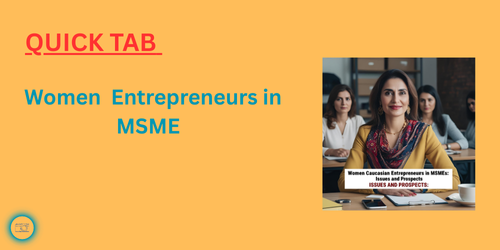
Women Entrepreneurs in MSMEs: Issues and Prospects.

Women Entrepreneurs in MSME Women entrepreneurs in MSME sectors are playing a crucial role in driving inclusive economic growth in India. Women entrepreneurs in MSME often face challenges such as limited access to finance and market opportunities. Women entrepreneurs in MSME are increasingly leveraging digital tools to expand their businesses.Women entrepreneurs in MSME benefit from government schemes like MUDRA and Stand-Up India, aimed at financial inclusion. Women entrepreneurs in MSME contribute significantly to rural development and employment generation. Women entrepreneurs in MSME struggle with social and cultural barriers that limit their business potential. What are the key challenges faced by women entrepreneurs in the MSME sector in India? Lack of property ownership for collateral, restricted access to financing, and limited exposure to formal business networks are just a few of the difficulties faced by women entrepreneurs in MSMEs. Women’s mobility and decision-making authority are frequently limited by societal biases and gender conventions. Furthermore, a lot of women balance domestic duties, which leaves little time for business development. Growth is also hampered by a lack of instruction in digital and financial literacy. Even with government assistance, few people are aware of the plans. Implementing more inclusive policies and focused capacity-building activities is essential since these barriers hinder their ability to scale their firms effectively and lower their competitiveness. How do government schemes and policies support women entrepreneurship in MSMEs? To encourage women’s entrepreneurship in MSMEs, the Indian government has launched a number of initiatives.  Women entrepreneurs can receive financial support and subsidized loans through programs like the Mahila Coir Yojana, Stand-Up India, and Pradhan Mantri MUDRA Yojana.  Training and marketing assistance are also provided under the Trade Related Entrepreneurship Assistance and Development (TREAD) program.  Women-led businesses are given preference in public procurement and grievance resolution under MSME Sambandh and Samadhan.  By enhancing market connections, talent development, and financing availability, these policies hope to create an environment that will motivate more women to start and maintain businesses in the MSME sector. In what ways can improving access to finance empower women-led MSMEs? Improving access to finance empowers women-led MSMEs by enabling them to invest in equipment, hire skilled labor, and scale operations. Without adequate funding, many women entrepreneurs remain confined to informal or home-based businesses. Access to credit builds financial independence and encourages risk-taking, innovation, and long-term planning. Special loan products with low interest, minimal collateral, and simplified documentation are essential. Financial inclusion also improves credit histories, allowing women to qualify for larger funding over time. Moreover, combining financial support with mentorship and training can boost confidence and decision-making skills, leading to more sustainable and competitive enterprises. What are the prospects of women entrepreneurship in emerging sectors within MSMEs? Women entrepreneurs have strong prospects in emerging MSME sectors such as green energy, healthcare, organic food processing, handmade and eco-friendly goods, and digital services. These areas often require moderate investment and align with women’s traditional skills and community-focused business models. The rise of digital tools and e-commerce platforms also reduces barriers to entry and allows women to reach wider markets. Supportive government policies, increasing demand for ethical products, and growing consumer awareness present new growth opportunities. With proper access to training, finance, and digital infrastructure, women-led MSMEs can lead innovation in these dynamic and socially impactful sectors. How can training and mentorship help increase the participation of women in the MSME sector? Enhancing women’s involvement in the MSME sector requires training and mentoring. Programs for skill development assist women in acquiring the technical know-how, financial literacy, and marketing abilities required for company expansion. Women who receive mentoring receive direction, boost their self-esteem, and gain access to networks and resources that they might not otherwise have. More women are considering entrepreneurship as a feasible career choice as a result of peer learning and exposure to role models. Initiatives from the public and private sectors that provide leadership development, digital literacy, and company incubation have produced fruitful results. When combined, mentoring and training close knowledge gaps and enable women to launch and grow profitable MSMEs. What role does social and cultural mindset play in shaping women’s participation in MSMEs? Women’s participation in MSMEs is greatly influenced by social and cultural perspectives. Patriarchal standards restrict women’s movement, education, and decision-making in many areas. Social expectations and family obligations frequently deter women from pursuing entrepreneurship. Even when they do, their confidence and risk-taking skills may be impacted by a lack of community or family support. Additionally, investors, suppliers, and customers undervalue women’s commercial acumen due to misconceptions about them. Education, awareness-raising initiatives, and promoting prosperous female entrepreneurs are all necessary to alter these attitudes. To promote gender equality in MSME leadership and participation, a positive cultural climate is necessary. How can digital technology and e-commerce platforms enhance opportunities for women entrepreneurs in MSMEs? By reducing obstacles to entry and increasing market access, digital technology and e-commerce platforms give women entrepreneurs in MSMEs a significant boost. Women can run enterprises from home and reach audiences across the country and the world with the help of platforms like social media, online marketplaces, and digital payments. Many women’s lifestyles are accommodated by e-commerce since it lessens dependency on physical stores and permits flexible work schedules. Digital literacy training enables them to interact with customers and streamline processes. This transition is further supported by corporate programs that provide tech-based training and grants, as well as government initiatives like Digital India. In general, technology improves women-led MSMEs’ profitability, efficiency, and visibility.

Women Entrepreneurs in MSMEs: Issues and Prospects. Read More »

rural

Role of MSMEs in Rural Employment Generation

How do MSMEs contribute to rural employment in India? MSMEs significantly contribute to non-urban employment by offering diverse job opportunities beyond traditional agriculture. They help absorb underemployed labor in villages and provide livelihoods through small manufacturing, services, and trade. These enterprises utilize local resources and skills, making them highly suitable for remote contexts. Employment is generated not only directly through hiring but also indirectly through supply chains, logistics, and local services. MSME also encourage entrepreneurship among villagers by enabling small business ownership with low capital investment . As they often operate in labor-intensive sectors like textiles, food processing, and handicrafts, they serve as engines of inclusive economic growth in rural India.  What types of MSMEs are most prevalent in rural areas? In village, MSMEs typically revolve around local strengths and resources. Agro-based industries such as food processing, dairy, and oil mills are common due to easy access to raw materials. Other prevalent MSMEs include handloom weaving, handicrafts, pottery, bamboo products, and coir-based manufacturing. These industries rely on traditional knowledge and manual skills, which are widely available in remote communities. Khadi and village industries, supported by institutions like KVIC, also play a major role. These enterprises often function as cottage or micro units, providing self-employment or engaging local workers on a small scale. Their low capital requirement and adaptability make them ideal for remote job creation. What government schemes support rural MSME employment? Several government schemes aim to promote rural employment through MSME development. The Prime Minister’s Employment Generation Programme (PMEGP) provides financial support to rural entrepreneurs for setting up micro-enterprises. MUDRA loans under the Pradhan Mantri Mudra Yojana offer easy access to credit for small businesses. Stand-Up India and Startup India promote inclusive entrepreneurship by supporting SC/ST and women entrepreneurs. Additionally, the SFURTI scheme supports cluster-based development of traditional industries. These programs also provide skill training, infrastructure development, and marketing support. By addressing key bottlenecks like finance and capacity building, these schemes help MSMEs grow and become sustainable sources of non-urban employment.  What challenges do rural MSMEs face in creating jobs? MSMEs face several challenges that hinder their job creation potential. One major issue is inadequate infrastructure, such as poor road connectivity, unreliable electricity, and limited internet access, which affect production and logistics. Access to affordable credit remains difficult due to lack of collateral and formal documentation. There is also a shortage of skilled labor in areas, which limits productivity and quality output. Market access is another concern, as businesses struggle to compete in urban and global markets without proper marketing and branding support. Regulatory complexities and delayed approvals further deter small entrepreneurs. Addressing these barriers is essential for MSMEs to thrive and create employment. How can rural MSMEs be strengthened to boost employment generation? Strengthening remote MSMEs requires a multi-pronged approach involving infrastructure development, financial inclusion, skill enhancement, and policy support. Improving roads, power supply, and digital connectivity can enhance business operations. Access to low-interest credit through simplified lending norms is critical. Skill development programs tailored to industries will help increase workforce productivity. Promoting entrepreneurship through awareness campaigns and incubation centers can foster innovation. Encouraging MSME participation in e-commerce platforms and linking them with national and international markets will widen their reach. Government policies must focus on reducing compliance burdens and offering tax incentives to nurture a business-friendly environment in areas. In what ways do MSMEs help reduce rural-to-urban migration in India? MSMEs play a crucial role in reducing rural-to-urban migration by creating meaningful employment opportunities within rural areas. Many people migrate to cities due to the lack of stable income sources in villages. However, MSMEs provide alternative livelihoods by promoting local industries such as agro-processing, handicrafts, textiles, and small-scale manufacturing. These enterprises make use of locally available raw materials and traditional skills, ensuring employment without the need for relocation. By fostering entrepreneurship, MSMEs encourage self-employment and strengthen the local economy. Government schemes like PMEGP and MUDRA also support businesses financially, making it feasible for people to start and sustain small ventures at the village level. Additionally, cluster development programs enhance infrastructure and market access, allowing enterprises to thrive. When workers find reliable incomes close to home, the pressure to migrate decreases significantly. Thus, MSMEs contribute not only to employment generation but also to social stability by minimizing urban overcrowding and preserving communities.

Role of MSMEs in Rural Employment Generation Read More »

MSME Loan and Grant Guide in India

MSME Loan and Grant Guide in India

MSME Loan and Grant Guide in India MSME Loan and Grant Guide in India offers a comprehensive overview of funding opportunities designed to empower small and medium enterprises. MSME Loan and Grant Guide in India helps entrepreneurs identify suitable government-backed schemes for starting or expanding their business. MSME Loan and Grant Guide in India explains eligibility requirements, step-by-step application processes, and required documentation. MSME Loan and Grant Guide in India is a valuable resource for understanding both traditional and alternative financing options. MSME Loan and Grant Guide in India ensures that business owners can avoid debt traps, scams, and misleading loan terms. MSME Loan and Grant Guide in India simplifies complex procedures and brings clarity to the financial support available across sectors. MSME Loan and Grant Guide in India enables startups and growing businesses to access funding without needing heavy collateral. MSME Loan and Grant Guide in India is tailored to help enterprises make informed financial decisions and achieve sustainable growth. What are the most accessible loan options for MSMEs in India, and how can entrepreneurs qualify? India offers several government-backed and bank-facilitated loan schemes tailored for MSMEs to improve financial inclusion and support entrepreneurship. The most accessible among them are MUDRA loans (under Pradhan Mantri MUDRA Yojana), which offer funding up to ₹10 lakh for micro-enterprises; Stand-Up India, which targets SC/ST and women entrepreneurs with loans between ₹10 lakh and ₹1 crore; and PMEGP (Prime Minister’s Employment Generation Programme), which combines subsidies with bank credit for setting up new enterprises. Additionally, CGTMSE (Credit Guarantee Fund Trust for Micro and Small Enterprises) offers collateral-free loans with a credit guarantee for up to ₹2 crore. To qualify, entrepreneurs must register under Udyam, have a viable business plan, maintain good creditworthiness, and provide necessary documents such as financial statements, identity/address proof, and project reports. Banks assess the borrower’s ability to repay through a combination of financial history, turnover, and sector potential. Newer fintech lenders have also eased accessibility by using alternative credit scoring, which benefits small and informal enterprises. How can MSMEs identify and apply for grants tailored to their industry or business stage? MSMEs can access grants by actively exploring resources from both central and state governments, as well as industry-specific bodies. Government portals like MSME Samarth, Startup India, SIDBI, and Atal Innovation Mission list various schemes designed for different sectors such as manufacturing, IT, agriculture, and green technology. Grants may target different stages of business development—startup, growth, or expansion. MSMEs should monitor these platforms regularly or subscribe to newsletters from industry associations to stay informed. Once a relevant grant is identified, MSMEs must assess the eligibility criteria, which could include Udyam registration, minimum turnover, employment targets, or innovation potential. Application processes often involve submitting detailed business proposals, audited financial statements, income tax returns, and sometimes video pitches or proof of concept. Many businesses also benefit from hiring grant consultants or working with local incubation centers that provide assistance with proposal writing, documentation, and follow-up. Keeping all compliance and tax filings up to date enhances the chances of grant approval and demonstrates operational transparency. What documents and financial records do lenders typically require for MSME funding approval? Lenders—whether banks, NBFCs, or fintech companies—follow a fairly standardized checklist when evaluating loan applications from MSMEs. Core requirements include KYC documents for promoters and the enterprise (Aadhaar, PAN, passport-sized photographs), business proof (Udyam certificate, shop establishment license, GST registration), and bank statements for the past 6–12 months to assess cash flow and financial discipline. For higher-value loans, especially above ₹10 lakh, lenders typically require audited financials—balance sheet, profit and loss account, and income tax returns for the past 2–3 years. In addition, applicants must submit a detailed project report or business plan, outlining loan usage, market potential, and revenue model. Ownership documents or lease agreements for business premises and machinery, if any, may also be needed. Some institutions may ask for collateral documents unless the loan is under a credit guarantee scheme like CGTMSE. A strong credit score (CIBIL score) and financial transparency improve the chances of approval, along with punctual GST and tax filings. What are the pros and cons of traditional bank loans vs. alternative financing (e.g., crowdfunding, angel investors)? Small and medium-sized enterprises (MSMEs) today have various options for financing, both traditional and alternative, each featuring unique advantages and disadvantages. Standard bank loans offered by public and private institutions typically come with lower interest rates, extended repayment periods, and access to government credit programs such as CGTMSE. These loans are ideal for businesses that are already established, demonstrate stable revenue streams, and possess a strong credit history. However, obtaining such loans can be a lengthy process that involves a lot of documentation and may require collateral. Additionally, it is often challenging for emerging or informal businesses to meet the qualification criteria. Alternative financing options encompass angel investments, venture capital, peer-to-peer lending, and crowdfunding platforms. These avenues usually provide quicker access to funds, often requiring less paperwork and, in the case of equity funding, no obligation for repayment. For startups and technology-focused firms, angel investors not only offer capital but also valuable mentorship and networking opportunities. On the downside, certain options like equity investments can lead to a loss of ownership, and alternatives such as crowdfunding may lack clear legal protections. Furthermore, the interest rates on unsecured loans from non-banking financial companies (NBFCs) or online lending platforms can be considerably higher. MSMEs need to carefully consider the long-term consequences versus immediate benefits when selecting the most appropriate financing option.  How can MSMEs avoid common pitfalls when securing loans or grants (e.g., debt traps, scams, unrealistic terms)? Securing external funding can accelerate growth, but MSMEs must exercise caution to avoid common traps. Debt traps often arise when businesses borrow more than they can repay, take on high-interest short-term loans, or use loans for unproductive expenses. To avoid this, MSMEs should conduct a realistic assessment of repayment capacity, create cash flow projections, and borrow strictly according to business needs. Scams are another threat—fraudulent

MSME Loan and Grant Guide in India Read More »

[variable_1] from [variable_2] has Just Bought Udyam Registration [amount] minutes ago.